Aes Cbc Encryption Example Aes Encryption For Mac
'Mode of operation' redirects here. For 'method of operating', see. In cryptography, a block cipher mode of operation is an algorithm that uses a to provide an such as. A block cipher by itself is only suitable for the secure cryptographic transformation (encryption or decryption) of one fixed-length group of called a. A mode of operation describes how to repeatedly apply a cipher's single-block operation to securely transform amounts of data larger than a block.
- Aes Cbc Encryption Example Aes Encryption For Mac
- Aes Cbc Encryption Example Aes Encryption For Mac Pro
What is AES CBC. AES-CBC (cipher block chaining) mode is one of the most used symmetric encryption algorithms. The data size must be nonzero and multiple of 16 bytes, which is the size of a “block”. The data is split into 16-byte blocks before encryption or decryption is started, then the operation is performed on each of the blocks.
Most modes require a unique binary sequence, often called an (IV), for each encryption operation. The IV has to be non-repeating and, for some modes, random as well. The initialization vector is used to ensure distinct are produced even when the same is encrypted multiple times independently with the same.
Aes Cbc Encryption Example Aes Encryption For Mac
Block ciphers may be capable of operating on more than one, but during transformation the block size is always fixed. Aar esign printer driver for mac. Block cipher modes operate on whole blocks and require that the last part of the data be to a full block if it is smaller than the current block size. There are, however, modes that do not require padding because they effectively use a block cipher as a. Historically, encryption modes have been studied extensively in regard to their error propagation properties under various scenarios of data modification. Later development regarded as an entirely separate cryptographic goal. Some modern modes of operation combine and in an efficient way, and are known as modes.
Contents. History and standardization The earliest modes of operation, ECB, CBC, OFB, and CFB (see below for all), date back to 1981 and were specified in, DES Modes of Operation. In 2001, the US (NIST) revised its list of approved modes of operation by including as a block cipher and adding CTR mode in, Recommendation for Block Cipher Modes of Operation.
Finally, in January, 2010, NIST added in, Recommendation for Block Cipher Modes of Operation: The XTS-AES Mode for Confidentiality on Storage Devices. Other confidentiality modes exist which have not been approved by NIST.
For example, CTS is mode and available in many popular cryptographic libraries. The block cipher modes ECB, CBC, OFB, CFB, CTR, and provide confidentiality, but they do not protect against accidental modification or malicious tampering. Modification or tampering can be detected with a separate such as, or a.
The cryptographic community recognized the need for dedicated integrity assurances and NIST responded with HMAC, CMAC, and GMAC. Was approved in 2002 as, The Keyed-Hash Message Authentication Code (HMAC), was released in 2005 under, Recommendation for Block Cipher Modes of Operation: The CMAC Mode for Authentication, and was formalized in 2007 under, Recommendation for Block Cipher Modes of Operation: Galois/Counter Mode (GCM) and GMAC. The cryptographic community observed that compositing (combining) a confidentiality mode with an authenticity mode could be difficult and error prone.
Aes Cbc Encryption Example Aes Encryption For Mac Pro
They therefore began to supply modes which combined confidentiality and data integrity into a single cryptographic primitive (an encryption algorithm). These combined modes are referred to as, AE or 'authenc'. Examples of AE modes are , ,. Modes of operation are nowadays defined by a number of national and internationally recognized standards bodies. Notable standards organizations include, (with ISO/IEC 10116 ), the, the, the national, and the.
Initialization vector (IV). Main article: An initialization vector (IV) or starting variable (SV) is a block of bits that is used by several modes to randomize the encryption and hence to produce distinct ciphertexts even if the same plaintext is encrypted multiple times, without the need for a slower re-keying process.
An initialization vector has different security requirements than a key, so the IV usually does not need to be secret. However, in most cases, it is important that an initialization vector is never reused under the same key. For CBC and CFB, reusing an IV leaks some information about the first block of plaintext, and about any common prefix shared by the two messages. For OFB and CTR, reusing an IV completely destroys security. This can be seen because both modes effectively create a bitstream that is XORed with the plaintext, and this bitstream is dependent on the password and IV only. Reusing a bitstream destroys security. In CBC mode, the IV must, in addition, be unpredictable at encryption time; in particular, the (previously) common practice of re-using the last ciphertext block of a message as the IV for the next message is insecure (for example, this method was used by SSL 2.0).
If an attacker knows the IV (or the previous block of ciphertext) before he specifies the next plaintext, he can check his guess about plaintext of some block that was encrypted with the same key before (this is known as the TLS CBC IV attack). Main article: A works on units of a fixed (known as a block size), but messages come in a variety of lengths. So some modes (namely and ) require that the final block be padded before encryption. Several schemes exist. The simplest is to add to the to bring its length up to a multiple of the block size, but care must be taken that the original length of the plaintext can be recovered; this is trivial, for example, if the plaintext is a style which contains no null bytes except at the end.
Slightly more complex is the original method, which is to add a single one, followed by enough zero to fill out the block; if the message ends on a block boundary, a whole padding block will be added. Most sophisticated are CBC-specific schemes such as or, which do not cause any extra ciphertext, at the expense of some additional complexity. And suggest two possibilities, both simple: append a byte with value 128 (hex 80), followed by as many zero bytes as needed to fill the last block, or pad the last block with n bytes all with value n.
CFB, OFB and CTR modes do not require any special measures to handle messages whose lengths are not multiples of the block size, since the modes work by the plaintext with the output of the block cipher. The last partial block of plaintext is XORed with the first few bytes of the last block, producing a final ciphertext block that is the same size as the final partial plaintext block. This characteristic of stream ciphers makes them suitable for applications that require the encrypted ciphertext data to be the same size as the original plaintext data, and for applications that transmit data in streaming form where it is inconvenient to add padding bytes. Common modes Many modes of operation have been defined. Some of these are described below.
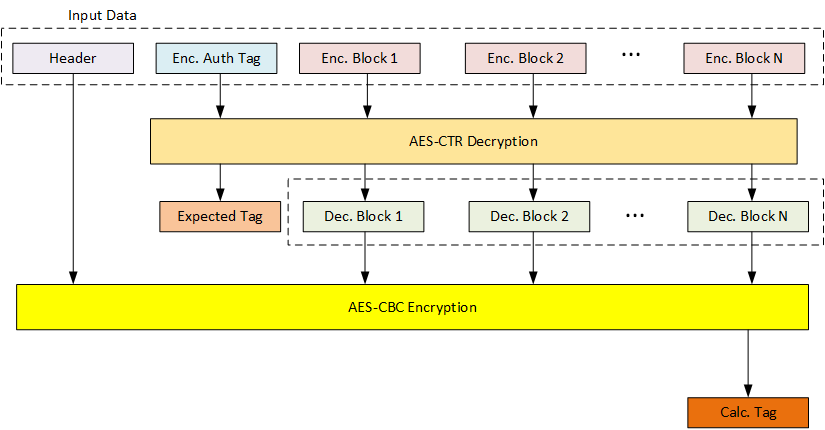
The purpose of cipher modes is to mask patterns which exist in encrypted data, as illustrated in the description of the. Different cipher modes mask patterns by cascading outputs from the cipher block or other globally deterministic variables into the subsequent cipher block. Main article: A number of modes of operation have been designed to combine and in a single cryptographic primitive. Examples of such modes are,. Modes are classified as single-pass modes or double-pass modes.
Some single-pass algorithms, such as, are encumbered by patents, while others were specifically designed and released in a way to avoid such encumberment. In addition, some modes also allow for the authentication of unencrypted associated data, and these are called (authenticated encryption with associated data) schemes. For example, EAX mode is a double-pass AEAD scheme while OCB mode is single-pass. Other modes and other cryptographic primitives Many more modes of operation for block ciphers have been suggested. Some have been accepted, fully described (even standardized), and are in use.
Others have been found insecure, and should never be used. Still others don't categorize as confidentiality, authenticity, or authenticated encryption – for example and hashing. Maintains a list of proposed modes for block ciphers at. Disk encryption often uses special purpose modes specifically designed for the application. Tweakable narrow-block encryption modes (, and ) and wide-block encryption modes ( and ) are designed to securely encrypt sectors of a disk (see ).
Block ciphers can also be used in other. They are generally used in modes of operation similar to the block modes described here. As with all protocols, to be cryptographically secure, care must be taken to design these modes of operation correctly. There are several schemes which use a block cipher to build a. See for descriptions of several such methods.
(CSPRNGs) can also be built using block ciphers. (MACs) are often built from block ciphers., and are examples. See also.
NIST Computer Security Division's (CSD) Security Technology Group (STG) (2013). Cryptographic Toolkit. From the original on November 19, 2012. Retrieved April 12, 2013. ^ Cryptography Engineering: Design Principles and Practical Applications. Ferguson, N., Schneier, B. And Kohno, T.
Indianapolis: Wiley Publishing, Inc. NIST Computer Security Division's (CSD) Security Technology Group (STG) (2013). Cryptographic Toolkit.
From the original on April 2, 2013. Retrieved April 14, 2013. Menezes, Paul C. Van Oorschot and Scott A. Vanstone (1996). From the original on 2005-03-07. CS1 maint: Uses authors parameter.
^ ISO JTC 1/SC 27 (2006). ISO Standards catalogue. From the original on 2012-03-17. CS1 maint: Uses authors parameter.
^ Kuo-Tsang Huang, Jung-Hui Chiu, and Sung-Shiou Shen (January 2013). International Journal of Network Security & Its Applications (IJNSA). (PDF) from the original on 2015-11-22. CS1 maint: Uses authors parameter. NIST Computer Security Division's (CSD) Security Technology Group (STG) (2013). Cryptographic Toolkit.
From the original on April 2, 2013. Retrieved April 12, 2013. Cryptosmith LLC.
From the original on 25 January 2015. Retrieved 7 January 2015. Moeller (May 20, 2004), from the original on June 30, 2012. (PDF).
(PDF) from the original on 29 March 2017. Retrieved 1 April 2017. Ehrsam, Carl H. Meyer, John L. Smith, Walter L. Tuchman, 'Message verification and transmission error detection by block chaining', US Patent 4074066, 1976. From the original on 7 January 2015.
Retrieved 7 January 2015. From the original on 16 July 2012.
Retrieved 28 April 2018. Kaufman, C.; Perlman, R.; Speciner, M. Network Security (2nd ed.). Upper Saddle River, NJ: Prentice Hall.
Proceedings, Crypto '89. Berlin: Springer. Archived from (PDF) on 2009-06-12. ^ (NIST), Author: Morris Dworkin. (PDF) from the original on 28 August 2017. Retrieved 28 April 2018.
W.; Parkin, G. 'The average cycle size of the key stream in output feedback encipherment'. Advances in Cryptology, Proceedings of CRYPTO 82. New York: Plenum Press. Jueneman, Robert R.
'Analysis of certain aspects of output feedback mode'. Advances in Cryptology, Proceedings of CRYPTO 82. New York: Plenum Press. Helger Lipmaa, Phillip Rogaway, and David Wagner. Comments to NIST concerning AES modes of operation: CTR-mode encryption. 2000. Niels Ferguson, Bruce Schneier, Tadayoshi Kohno, Cryptography Engineering, page 71, 2010.
Lipmaa, Helger; Wagner, David; Rogaway, Phillip. (PDF) from the original on 2015-02-26. From the original on 24 October 2017. Retrieved 28 April 2018. From the original on 23 March 2018.
Retrieved 28 April 2018., Pompiliu Donescu, 'Fast Encryption and Authentication: XCBC Encryption and XECB Authentication Modes'. Fast Software Encryption, 2001: 92–108. Charanjit S. Jutla, 'Encryption Modes with Almost Free Message Integrity', Proc. Eurocrypt 2001, LNCS 2045, May 2001.
Commerce, Computer Security Division, Information Technology Laboratory, National Institute of Standards and Technology, U.S. Department of. From the original on 4 September 2017. Retrieved 28 April 2018.